News media
RELEASE: On Constitution Day, The American Crisis report warns: “This is not the time to look away.”
Media inquiries: https://www.americancrisis.report/media
Report identifies elections, domestic use of military force, and compounding economic, climate and public-health emergencies as potential crisis points over the next six months
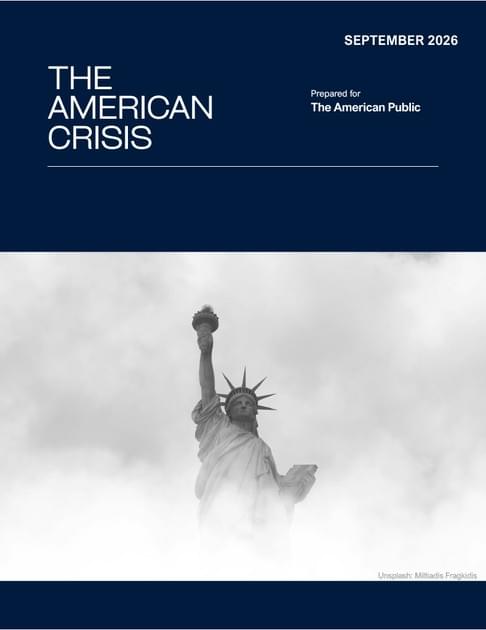
WASHINGTON DC — A new 30 page report by a group of scholars, community leaders, and democracy practitioners warns that the United States is entering a consequential six-month period in which threats to election administration, constitutional governance and civil society could converge with economic, climate or public-health emergencies.
The American Crisis, released today in advance of the November 3 midterm elections, examines three broad categories with the potential for escalated crisis: interference with the administration and peaceful outcome of the 2026 elections; escalation in the domestic deployment of military and paramilitary forces; and emerging financial, climate, public-health or other shocks that could compound political instability. The report's baseline for the election is straightforward: every qualified voter should be able to vote and have that vote counted, and duly certified winners should be able to take office without obstruction.
Inspired by Thomas Paine's pamphlet of the same name, 250 years after the nation's founding, the The American Crisis report is an actionable resource for communities, public servants and institutions seeking to protect democratic processes and prepare for potential disruptions. It does not prescribe a single strategy or claim to be comprehensive; instead, it draws on scholars and practitioners to help communities establish their own priorities and responses.
“The central message of this report is that while not every scenario we examine is inevitable, the warning signs are serious enough that preparation cannot wait,” said Dr. Ben Manski, a social movement scholar and member of the Sociology faculty at George Mason University. “Americans already possess enormous democratic capacities in our communities and institutions. The task now is to connect that capacity, prepare together, and ensure that our society withstands whatever pressures the coming months bring.”
The report argues that significant democratic-response capacity already exists across the country but remains fragmented. Neighborhood networks, labor organizations, faith communities, public institutions, schools and universities, legal advocates and local governments often lack shared protocols and practiced mechanisms for acting together during a crisis. The report therefore calls not simply for creating new organizations, but for connecting, testing and mobilizing capabilities that already exist.
Among its recommendations, The American Crisis calls for stronger communication and coordination among neighborhoods, municipalities, counties and states; greater public planning by civic institutions; scenario exercises and shared crisis indicators; stronger election-protection infrastructure; and renewed congressional assertion of its constitutional responsibilities.
The report places particular emphasis on cities and communities. Its authors argue that municipalities can play a leading role in preserving democratic continuity because of their proximity to residents and their responsibility for many essential public services. The report calls for increased communication, coordination and solidarity across communities and between local and state institutions.
It also recommends treating communications as essential crisis infrastructure – including trusted messengers, rapid documentation and response capabilities, secure cross-organizational communications and alternatives capable of functioning during internet or platform disruptions.
The authors urge institutions to conduct practical preparations before a crisis occurs, including scenario exercises, common indicators, decision protocols and exercises that test whether organizations can work together under pressure.
Finally, the report issues a direct appeal to Congress, writing that, “If the U.S. is to remain a republic, members of Congress must take seriously their oath to uphold the Constitution by ensuring a successful democratic transition of power.”
“The choice presented in this report is ultimately constructive,” said Dr. Michael Shank, a visiting scholar at George Mason University and adjunct faculty at New York University. “Preparedness is not panic. It means strengthening the relationships and institutions that allow Americans to resolve profound disagreements democratically, prevent violence, protect elections and keep communities functioning in moments of extraordinary stress.”
The report grew out of a July 2026 convening held during the 250th year of the nation's founding and brings together conclusions and recommendations from scholars and practitioners examining the challenges of the coming six months.
The report carries more than 50 prominent signatories from academia, labor, community organizations, pro-democracy, municipal-government, and civil-society backgrounds, and is authored by Dr. Ben Manski, Dr. Michael Shank and April Doner.
# # #